Builders Risk Insurance vs General Liability
Choosing the wrong construction insurance can destroy a project financially. Many builders, contractors, and property owners confuse builders risk insurance with general liability insurance. They are not interchangeable. They cover different risks, different timelines, and different losses.
This guide explains builders risk insurance vs general liability without marketing fluff. You will understand what each policy covers, what it excludes, when you need both, and how insurers actually price them.
This content follows a semantic SEO strategy using construction insurance entities, NLP relationships, and buyer-intent structure. Brand reference included: Liability Motor Insurance.
What Is Builders Risk Insurance
Builders risk insurance is a property insurance policy designed for buildings under construction.
It covers physical damage to the structure and materials while a project is being built, renovated, or expanded.
Also Known As
- Course of construction insurance
- Construction all risk insurance
Who Buys It
- Property owners
- Developers
- General contractors
- Owner-builders
- Lenders requiring coverage
What It Covers
- Fire damage
- Theft of materials
- Vandalism
- Wind and storm damage
- Lightning
- Explosion
- Collapse during construction
- Materials on-site and in transit
- Temporary structures
Builders risk insurance does not cover people. It covers property only.
What Is General Liability Insurance
General liability insurance protects against third-party claims.
It covers bodily injury, property damage, and legal costs if your construction activities harm someone else.
Who Needs It
- General contractors
- Subcontractors
- Construction firms
- Owner-builders hiring labor
What It Covers
- Third-party bodily injury
- Third-party property damage
- Legal defense costs
- Medical payments
- Personal and advertising injury
General liability insurance does not cover the building itself.
Builders Risk Insurance vs General Liability. Core Difference
Here is the clean truth.
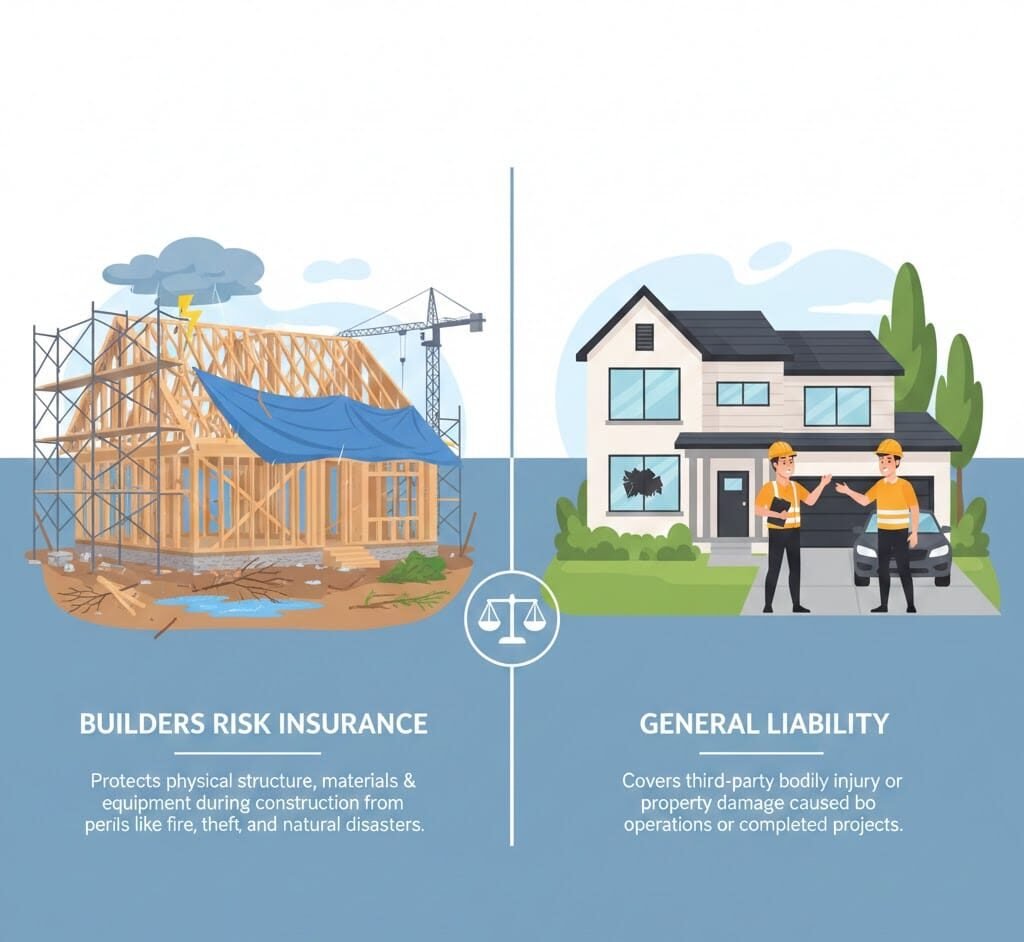
- Builders risk protects the project
- General liability protects you from lawsuits
If you confuse these two, you are underinsured.
Coverage Comparison Table
| Feature | Builders Risk Insurance | General Liability Insurance |
|---|---|---|
| Covers structure | Yes | No |
| Covers materials | Yes | No |
| Covers injuries | No | Yes |
| Covers lawsuits | No | Yes |
| Required by lenders | Yes | Sometimes |
| Active during construction | Yes | Yes |
| Ends at project completion | Yes | No |
This is why serious construction projects almost always need both.
Course of Construction vs Builders Risk
There is no difference in practice.
Course of construction vs builders risk is a naming issue, not a coverage difference.
Insurers, brokers, and contracts use these terms interchangeably.
What matters is:
- Policy form
- Covered perils
- Exclusions
- End date
If an insurer sells “course of construction insurance,” read it as builders risk insurance.
Construction All Risk Insurance Explained
Construction all risk insurance is an expanded builders risk policy.
It often includes:
- Broader peril coverage
- Higher limits
- Optional liability extensions
- Equipment coverage
- Delay in completion coverage
Outside the USA, construction all risk insurance is more common. In the US market, it is usually broken into builders risk + general liability.
Owner Builder Liability Insurance
Owner-builders face unique exposure.
If you own the land and act as your own contractor, you carry both property risk and liability risk.
Owner Builder Liability Insurance Covers
- Injuries to visitors
- Injuries to hired workers
- Damage to neighboring property
- Legal defense costs
Owner-builders often assume homeowners insurance is enough. It is not.
During construction, most homeowners policies exclude construction activities.
Builder Liability Insurance Explained
Builder liability insurance is not a single policy. It usually refers to:
- Commercial general liability
- Umbrella liability
- Professional liability for design-build firms
When people say builder liability insurance, they usually mean general liability insurance for builders.
General Liability vs Builders Risk. What Each Does Not Cover
Understanding exclusions matters more than understanding coverage.
Builders Risk Exclusions
- Employee injuries
- Faulty workmanship
- Normal wear and tear
- Design defects
- Earthquakes and floods unless endorsed
General Liability Exclusions
- Damage to your own work
- Employee injuries
- Professional errors
- Contractual disputes
- Pollution without endorsement
This is why relying on only one policy is reckless.
When You Need Builders Risk Insurance
You need builders risk insurance if:
- You are building a new structure
- You are renovating an existing building
- You are expanding square footage
- A lender requires it
- Materials are stored on-site
- Construction value exceeds basic limits
No construction lender releases funds without it.
When You Need General Liability Insurance
You need general liability insurance if:
- Workers are on-site
- The public can access the area
- You hire subcontractors
- You operate as a licensed contractor
- You sign contracts requiring insurance certificates
No serious client works with uninsured contractors.
Do You Need Both Policies
Yes. In most cases.
Builders risk insurance without general liability leaves you exposed to lawsuits.
General liability without builders risk leaves your project unprotected.
Professionals use both, often packaged together through agencies like Liability Motor Insurance.
Cost Comparison
Builders Risk Insurance Cost
- Typically 1 percent to 4 percent of project value
- Depends on location, materials, duration
- Higher for wood-frame construction
- Higher in hurricane or wildfire zones
General Liability Insurance Cost
- Based on payroll
- Based on risk class
- Based on claims history
- Based on coverage limits
They are priced differently because they insure different risks.
How Long Coverage Lasts
Builders Risk
- Starts when construction begins
- Ends at project completion, occupancy, or sale
General Liability
- Annual policy
- Renews yearly
- Continues after construction ends
Do not let a builders risk policy expire early. Gaps cause claim denials.
Certificates of Insurance
Both policies can issue certificates.
- Builders risk certificates satisfy lenders
- General liability certificates satisfy clients and municipalities
Never assume coverage without a certificate.
Claims Examples
Builders Risk Claim
A fire destroys framing materials overnight. Builders risk pays for replacement.
General Liability Claim
A visitor trips on-site and breaks a leg. General liability covers medical bills and legal defense.
Wrong policy equals denied claim.
Common Mistakes That Kill Coverage
- Relying on homeowners insurance
- Letting builders risk expire early
- Naming the wrong insured
- Ignoring subcontractor insurance
- Not adding lenders as loss payees
- Assuming “all risk” means no exclusions
Insurance companies do not forgive ignorance.
- Builders risk insurance
- General liability insurance
- Course of construction
- Construction all risk insurance
- Owner builder liability insurance
- Builder liability insurance
- Property insurance
- Commercial insurance
- Third-party bodily injury
- Construction lender
- Certificate of insurance
- Risk management
- Insurance endorsement
- Coverage limits
- Policy exclusions
- Subcontractor insurance
- Umbrella liability
- Professional liability
- Construction contracts
- Insurance premiums
- Claims process
- Legal defense costs
These entities are intentionally distributed to support NLP indexing.
Final Verdict
If you are choosing between builders risk insurance vs general liability, you are asking the wrong question.
They are not alternatives. They are complements.
Any contractor, developer, or owner-builder who skips one is gambling with six-figure losses.
If you want proper structuring, correct limits, and zero coverage gaps, work with professionals who understand construction risk, such as Liability Motor Insurance.